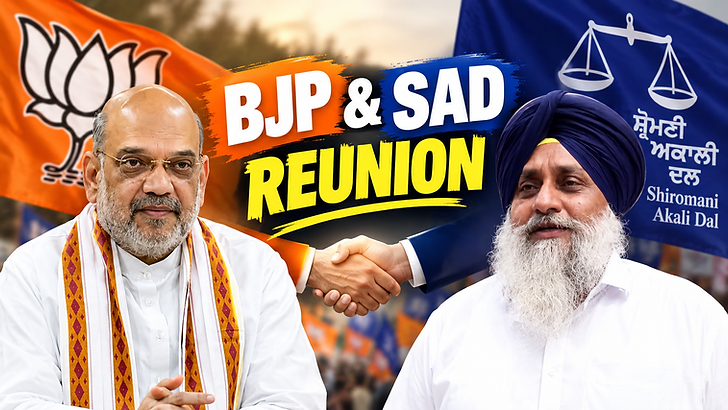
Chandigarh/New Delhi, October 24, 2026 — The Shiromani Akali Dal (Badal) and the Bharatiya Janata Party are reportedly close to formalising a renewed electoral alliance ahead of the Punjab Assembly elections, with the Akali Dal set to regain its traditional position as the senior partner in the state. Sources say the SAD may contest more than 60 of Punjab’s 117 Assembly seats, while the BJP is expected to accept a substantially reduced share after initially seeking the “big brother” role.
A political turnaround
The reported agreement marks a striking reversal after the two parties ended their 24-year-old partnership in September 2020 over the Centre’s now-repealed three farm laws. The SAD had then quit the NDA, with Harsimrat Kaur Badal resigning from the Union Cabinet, accusing the BJP-led government of disregarding farmers’ interests.
The state does not have a water crisis. It has a cropping-pattern crisis that expresses itself as a water crisis.
The free-power regime for tube wells is the obvious target. It is also the hardest to touch: three previous attempts to meter agricultural power ended in retreat within a single harvest season.
Under the earlier arrangement, the SAD contested 94 Assembly seats and the BJP 23. The new formula, according to sources cited in The Wire, would return the Akali Dal to the dominant position, with the BJP’s quota reduced and any seats allocated to the breakaway Shiromani Akali Dal (Punar Surjit) to be carved out of the BJP’s share.
Why the BJP relented
For the BJP, the calculation appears rooted in electoral arithmetic. Despite years of organisational expansion, the party has struggled to convert its national strength into a broad Punjab base, particularly in rural and Panthic constituencies where the Akali Dal retains traditional influence. Sources suggest the BJP concluded that it needed the SAD to make a credible bid in the state election.
The shift also follows a change in senior BJP messaging. Union Home Minister Amit Shah recently spoke of an “NDA government” in Punjab, rather than exclusively a BJP government, while SAD president Sukhbir Singh Badal said his party was open to an alliance with parties sharing its ideology and programme.
Seat-sharing and faction issue
Seat-sharing remains the central unresolved issue. Punjab BJP president Kewal Singh Dhillon has publicly maintained that the party is preparing to contest all 117 seats, and BJP insiders say any final decision must come from the party’s central leadership
A further complication is the SAD (Punar Surjit), the faction led by Giani Harpreet Singh. SAD leaders reportedly want the splinter group to merge back into the parent party, but differences between its leadership and Sukhbir Badal’s camp persist. For now, the reported plan is to accommodate the faction within the BJP’s seat quota rather than the SAD’s.
What it means for Punjab
A formal SAD-BJP pact would reshape the anti-incumbency contest against the Bhagwant Mann-led Aam Aadmi Party government. The Akali Dal brings a rural and Panthic support base, while the BJP offers organisational resources and a national platform; together, they would seek to present themselves as the principal alternative to both the AAP and the Congress.
However, the alliance carries political risk. The 2020 farm-law rupture remains a sensitive issue among Punjab’s farming communities, and opponents are likely to question whether the parties’ reconciliation reflects principle or electoral necessity. Neither party has yet issued a formal announcement, and the final seat-sharing arrangement will determine whether the reported “done deal” becomes a durable political realignment.