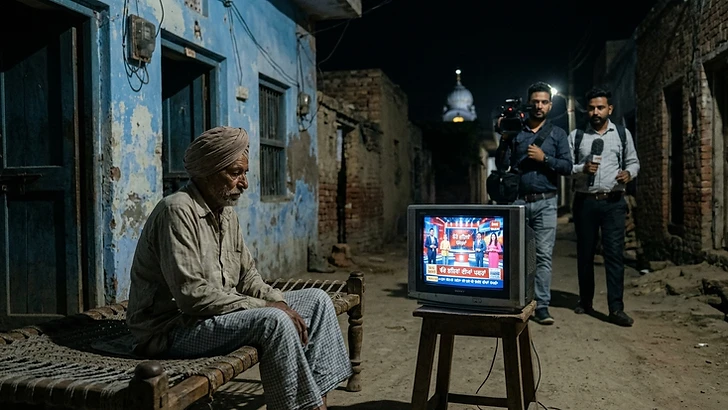
Punjabi media has become digitally louder but journalistically thinner. While YouTube channels, Facebook pages and independent websites have expanded rapidly, much of the coverage remains concentrated on Chandigarh, Ludhiana, Amritsar and Jalandhar, leaving small towns, rural Punjab and district-level governance under-reported.
A big-city blind spot
Punjab’s mainstream media still treats the state largely as a story about its political capital and a few large cities. Press conferences, Vidhan Sabha proceedings, party rivalries, senior leaders and urban crime receive continuous attention, while panchayat disputes, school and health-system failures, drug enforcement, land records, local industry, migrant labour and village-level corruption often disappear from the news agenda.
This creates a distorted picture of Punjab. A viewer may know every statement made by the Chief Minister or opposition leaders, but may not receive sustained reporting on why a government hospital in a sub-division lacks staff, why a local industrial unit has shut down, or how a panchayat’s development funds were spent. The absence of such reporting weakens democratic accountability at the level where most citizens actually experience the state.
If a district has no reporter, it has no accountability.
Digital growth, shallow capacity
Digital outlets promised to flatten this geography. In practice, most concentrated the same way, chasing the same urban audience advertisers reward.
The farmers’ movement of 2020–21 was a turning point. Frustrated with the perceived limitations of mainstream television and newspapers, many Punjabi journalists and commentators moved online, creating Facebook pages, YouTube channels and small news websites. Journalists estimate that around 200 such vernacular digital outlets emerged, particularly on Facebook and YouTube.
This expansion has real value: it has brought new voices into public debate, enabled faster reporting, and sometimes broken stories before traditional media picks them up. The Indian Express reports that major scoops increasingly surface first on YouTube channels or niche websites before entering television debates and mainstream coverage.
But the model has serious limits: Many channels rely on one or two people, often without legal, editorial or fact-checking support. Content is dominated by live streams, political commentary, speeches, press conferences and short clips rather than field reporting. Revenue depends heavily on Facebook and YouTube algorithms, encouraging sensational headlines, conflict-driven debate and high-volume posting. Deep investigations are expensive and slow, so they struggle to compete with reels, live videos and instant political reaction. The line between journalism, political messaging and paid influence has become increasingly blurre
The missing investigative culture
Punjab needs investigative journalism more than ever, yet it remains the weakest part of the media ecosystem. Investigative reporting requires time, travel, documents, legal protection, data skills and editorial backing—resources that most small digital outlets do not possess. The consequence is predictable: allegations circulate faster than evidence. A claim about corruption, drugs, police action or electoral manipulation may go viral, but it is rarely followed by a documented series examining records, interviewing affected people, seeking official responses and testing competing explanations. This does not mean all digital journalists are irresponsible; many work under severe constraints. It means the system rewards speed and outrage more than verification.
Government influence and pressure
The AAP government’s relationship with Punjabi media has intensified concerns about independence. An RTI reply showed that the Punjab government spent ₹37.36 crore on advertisements between March and May 2022, including ₹20.15 crore on television and radio and ₹17.21 crore on newspapers. Critics argued that advertising power can reward favourable coverage and punish critical outlets; AAP defended the spending as a legitimate way to communicate its governance model. More recently, the Reporters’ Collective reported that since October, AAP had claimed copyright over at least 48 videos and posts uploaded by journalists on Facebook that were critical of the Punjab government. The affected pages included those of small-town and tier-three journalists such as RMB Television, Lok Awaz TV, Maninderjeet Sidhu, Rattandeep Singh Dhaliwal and Parmeet Singh Bidowali.
There have also been disputes involving Punjab Kesari. The group alleged targeted action after raids on its business establishments and said government advertisements were stopped from 2 November 2025; the AAP government maintained that the action related to alleged violations of food, excise and pollution laws and had nothing to do with journalism. These competing claims underline the wider problem: when government advertising, regulatory action and political pressure intersect with media ownership, the public finds it difficult to distinguish accountability from retaliation.
Why small-town journalism matters
Punjab’s real democratic test lies outside Chandigarh. A strong local media ecosystem should ask: Are village development funds being used properly? Are government schools and health centres functioning? Are drug-destruction claims matched by enforcement and rehabilitation outcomes? Are farmers receiving timely compensation, crop procurement and reliable advisory services? Are local police stations, municipal bodies and panchayats answerable to residents? Are small manufacturers, workers and unemployed youth represented in policy debates? Without reporters based in districts and small towns, these questions are left to WhatsApp forwards, political pages and rumour. That vacuum damages public trust and allows misinformation to fill the space where verified local journalism should be.
What Punjab media needs
Punjabi media does not need more channels merely repeating political statements. It needs a structural shift toward credible, locally rooted journalism: District-based reporting desks in places such as Bathinda, Mansa, Barnala, Sangrur, Moga, Ferozepur, Pathankot, Hoshiarpur and Fazilka. Independent funding models that reduce dependence on government advertisements and political patrons. Fact-checking units and legal support for small digital journalists. Training in RTI, data journalism, court records, budget analysis and mobile reporting. Collaboration between established media houses and independent creators for investigations that individual channels cannot afford. Clear editorial standards separating news, opinion, sponsored content and political advocacy. Punjab’s digital media revolution has given the state a larger public sphere, but not yet a stronger one. Unless Punjabi journalism moves beyond big-city press conferences and viral political clips, it will continue to cover the noise of power while missing the realities of Punjab.