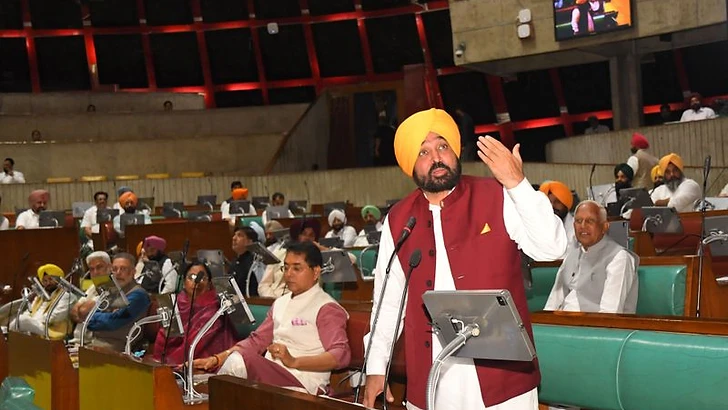
The Punjab Vidhan Sabha’s resolution demanding an independent inquiry into alleged electoral “irregularities” under Chief Election Commissioner Gyanesh Kumar is being presented as a defence of democracy. But its timing, language, and the central role of Arvind Kejriwal’s Delhi-centric grievances raise a serious question: is the Punjab government protecting Punjab’s voters—or using Punjab’s Assembly as a political instrument for AAP’s national battle with the BJP?
What the Assembly did
On October 23, the Punjab Assembly passed a government resolution moved by Finance Minister Harpal Singh Cheema seeking an “independent, impartial and credible” investigation into alleged irregularities in electoral rolls and the Election Commission’s functioning under CEC Gyanesh Kumar. It also said criminal proceedings should follow if evidence of wrongdoing emerged, and copies are to be sent to the President, Prime Minister, and CEC.
Chief Minister Bhagwant Mann alleged that voters were being shifted between states and referred to the reported deletion of around 40,000 votes in the New Delhi constituency, where Kejriwal lost the 2025 Delhi election by about 5,000 votes. The resolution therefore connects Punjab’s legislature directly to a constituency and electoral defeat that belong to Delhi, not Punjab.
A Punjab issue—or Kejriwal’s issue?
The stated concern is nationwide: alleged large-scale deletion of eligible voters during the Special Intensive Revision (SIR) of electoral rolls. That is a legitimate subject of public scrutiny, because the right to vote is constitutional and any credible evidence of wrongful deletion deserves investigation.
But the political emphasis was unmistakably Delhi-centred. AAP leaders repeatedly cited Kejriwal’s New Delhi seat, claimed that deleted votes caused his defeat, and framed the SIR as a BJP-led operation against Opposition voters. Cheema even alleged that the same “strategy” was later used in Bihar and West Bengal.
This creates an uncomfortable contradiction. Punjab has no SIR-linked state election immediately before it, and the resolution does not identify a comparable, evidence-based Punjab-specific electoral crisis requiring the state legislature’s intervention. Instead, the Assembly appears to have become a platform for AAP’s national narrative on “vote chori,” with Punjab’s institutional authority deployed to amplify Kejriwal’s personal and party-political grievance.
Is Kejriwal using Punjab?
The question is not whether Kejriwal has the right to challenge the Election Commission—he does, and every party and citizen does. The question is whether the Punjab government should convert the state Assembly into an extension of AAP’s national campaign.
AAP governs only in Punjab. Its national ambitions, however, depend heavily on positioning itself as the principal anti-BJP Opposition force after its defeat in Delhi. A resolution against the CEC allows AAP to achieve three goals at once: attack the BJP, revive the claim that Kejriwal’s Delhi loss was engineered, and present Punjab’s government as a national resistance front.That is why the resolution looks less like a Punjab governance initiative and more like a carefully scripted Delhi agenda. If the real issue were Punjab’s electoral integrity, the government should have presented concrete Punjab-specific cases: constituencies affected, numbers of wrongful deletions, complaints filed, responses received from electoral officers, and remedial action taken. Instead, the most prominent example offered was Kejriwal’s own Delhi constituency.
The weakness of the resolution
A resolution demanding accountability is not itself evidence of wrongdoing. The reports make clear that the Assembly was demanding an inquiry into allegations; its passage does not establish that electoral manipulation occurred.
The claim that 14 crore votes were “arbitrarily deleted” is an extraordinarily serious allegation. Yet the Assembly resolution, as reported, does not provide a verified Punjab-specific audit, independent forensic evidence, or a list of affected voters. It relies on broad national claims and AAP’s political interpretation of the SIR process.
There is also a procedural irony. The resolution was described as “unanimous,” but Congress, BJP, and Akali legislators were absent from the House when it was passed by voice vote. A claim of consensus is politically useful, but it does not carry the same democratic weight when the principal Opposition parties are not present to contest or support the motion.
Punjab deserves better
Punjab faces real issues that directly affect its people: drug abuse, agrarian distress, industrial stagnation, unemployment, debt, law and order, and the quality of public services. A full Assembly session spent attacking the CEC over a dispute rooted largely in Delhi’s electoral politics risks reducing Punjab’s legislature to a satellite of AAP headquarters.
If Kejriwal believes the Delhi election was stolen, the appropriate course is to pursue legal remedies, submit documented complaints to the Election Commission, seek judicial review where available, and produce verifiable evidence. Punjab’s Chief Minister and ministers should not be required to fight that battle on his behalf.
The Punjab Assembly has every right to defend the voting rights of Punjabis. But it should do so with Punjab-centric evidence, not by turning the state’s constitutional institution into a megaphone for AAP’s national confrontation with the BJP. Until the government demonstrates a clear, Punjab-specific electoral failure, the unavoidable question remains: is Bhagwant Mann governing Punjab, or is he executing Arvind Kejriwal’s Delhi agenda from Chandigarh?