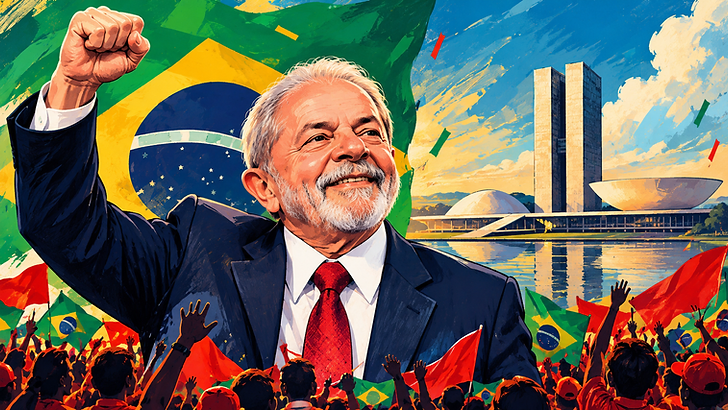
Brazil’s presidential election has delivered a dramatic political comeback. Luiz Inácio Lula da Silva has defeated far right senator Flávio Bolsonaro, winning 51.79 per cent of valid votes against his rival’s 48.21 per cent. Yet the victory has immediately been overshadowed by a familiar and troubling response: the defeated candidate’s refusal to accept the result.
Flávio Bolsonaro has described the election process as unacceptable and announced that he will seek to have the result annulled. His objection centres on an extraordinary last minute judicial decision to extend voting hours by two hours, following concerns about transport difficulties and severe weather. The circumstances deserve scrutiny, but the existence of an unusual decision does not, by itself, prove that an election was stolen.
The central question is whether Brazil’s political leaders will respect the democratic process or encourage millions of citizens to believe that an election is legitimate only when their preferred candidate wins.
When losing an election becomes a threat to democracy,/h2>
Democracy is not simply the right to vote. It also requires political leaders to accept legitimate outcomes, respect independent institutions and recognise that their opponents have the same democratic rights as their supporters.
A candidate is entitled to challenge an election through lawful procedures. Electoral authorities and courts must investigate credible allegations, provide transparent explanations and correct genuine irregularities. But there is a fundamental difference between requesting a lawful review and declaring an election illegitimate before sufficient evidence has been established.
That distinction is increasingly important in a political environment where allegations of fraud can spread faster than verified facts.
When leaders repeatedly cast doubt on elections without demonstrating that the results are invalid, they risk undermining public confidence in the very institutions that make democracy possible. Courts become political enemies, election officials become targets of suspicion, and citizens are encouraged to trust partisan claims over verifiable evidence.
The danger is not confined to Brazil. It reflects a wider international pattern in which some political movements treat democratic institutions as legitimate only when those institutions deliver the result they want.
The Bolsonaro movement and the rise of authoritarian politics
The most concerning aspect of this election is the political movement surrounding the Bolsonaro family and its relationship with democratic institutions.
Flávio Bolsonaro’s response echoes the refusal of his father, former president Jair Bolsonaro, to accept his defeat in the 2022 election. That earlier dispute went beyond ordinary political disagreement. Some supporters gathered outside military installations and called for intervention by the armed forces to prevent Lula from taking office.
Brazil’s military subsequently published a report that identified potential areas for improvement in the electoral system but did not substantiate the fraud allegations made by Bolsonaro supporters. Other reviews also failed to establish evidence of widespread electoral manipulation.
Jair Bolsonaro was later sentenced to 27 years in prison in connection with a plot to remain in power after losing the 2022 election.
These events provide essential context for understanding why the latest refusal to concede is so serious. The concern is not that every conservative voter is authoritarian, or that every criticism of an election is illegitimate. The concern is that a political movement can normalise the rejection of democratic outcomes and make distrust of institutions a permanent feature of its identity.
Authoritarian politics does not always begin with the abolition of elections. Sometimes it begins with something more subtle: convincing supporters that only their side represents the real people, that opponents are enemies of the nation, and that independent institutions cannot be trusted whenever they deliver an unfavourable decision.
Why are Bolsonaro’s supporters rejecting the result?
There are several factors behind the reaction.
First, the last minute extension of voting hours. The decision was unusual and deserves a clear explanation. Flávio Bolsonaro argues that the rules were changed at the last moment. However, both campaigns had requested extensions in certain areas for different reasons. Legal experts have questioned whether the circumstances provide sufficient grounds to invalidate the overall result.
Second, deep political polarisation. Brazil remains divided over economic management, crime, corruption, social policy and the country's international direction. For many Bolsonaro supporters, this election represents much more than a disagreement over government policy. It is a contest over the country's future and national identity.
Third, distrust of political and judicial institutions. Bolsonaro's movement has long challenged the credibility of Brazil's electoral system. When such claims are repeated over time, supporters may become more willing to interpret an unexpected result as evidence of wrongdoing, even when independent verification does not support that conclusion.
Fourth, the political cost of defeat. For movements built around strong personalities and claims of national rescue, accepting defeat can be difficult. Conceding means acknowledging that millions of citizens have chosen another direction. Rejecting the result can instead preserve the narrative that the leader was denied victory by an establishment supposedly working against the people.
These factors help explain the reaction, but they do not establish that the election was fraudulent. A political explanation is not the same as proof.
The warning for democracies around the world
Brazil's election should be understood against a wider international backdrop of rising populism, political extremism and declining trust in institutions.
Across different countries, political movements have increasingly used similar tactics: portraying opponents as existential threats, attacking journalists and independent institutions, questioning election results, and presenting a single leader as the only legitimate representative of the people.
This pattern can be dangerous regardless of whether it comes from the right or the left. Authoritarianism is defined not simply by a political label, but by a willingness to weaken democratic checks and balances, undermine accountability and place personal or partisan power above the rule of law.
The Bolsonaro movement is particularly relevant to this debate because of the events surrounding the 2022 election and the subsequent legal proceedings involving Jair Bolsonaro.
The lesson for other democracies is clear. Institutions should not be taken for granted simply because they have survived previous political crises. They depend on political leaders accepting limits on their power and citizens defending the principle that electoral competition must take place within democratic rules.
Lula's victory does not mean every concern disappears
Lula's re-election should not be treated as proof that Brazil's democratic challenges are over.
His government will still face serious questions about the cost of living, public security, corruption, economic management and national unity. A narrow election victory also means that almost half of valid voters supported his opponent. Those citizens deserve representation, respect and a meaningful place in democratic debate.
Lula must govern beyond his political base, protect institutional independence and demonstrate that democratic government can deliver tangible improvements in people's lives.
Democracy requires more than defeating an authoritarian tendency at the ballot box. It requires the winning side to govern responsibly and the losing side to remain free to criticise, organise and compete in future elections.
The same standard must apply to every political leader.
The real test is whether political power remains accountable
Brazil's election presents a fundamental choice. Political leaders can acknowledge the result, pursue legitimate legal challenges where evidence exists, and allow democratic institutions to do their work. Or they can continue to encourage suspicion, deepen divisions and persuade supporters that an unfavourable outcome must be illegitimate.
The second path carries serious risks. Once citizens lose faith in peaceful transfers of power, political conflict can move beyond parliamentary debate and legal proceedings into street confrontation, intimidation and demands for extra constitutional intervention.
The danger of authoritarian politics lies not only in what a leader does while in office, but also in what supporters are persuaded to accept in the leader's name.
Lula has won the election. The result is a setback for the Bolsonaro movement, but the deeper struggle over Brazil's democratic future is far from settled.
The real measure of a democracy is not whether our preferred candidate wins. It is whether we are prepared to respect the democratic rules when our preferred candidate loses.