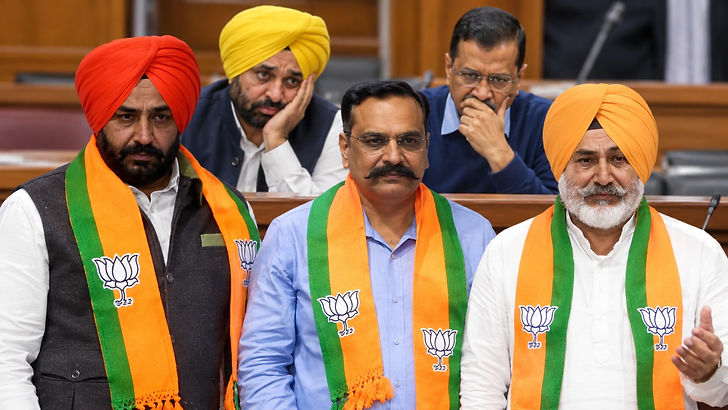
Chandigarh/New Delhi, November 1, 2026: In a major political blow to Punjab’s ruling Aam Aadmi Party (AAP) ahead of the 2027 Assembly elections, three sitting AAP MLAs Harmeet Singh Pathanmajra (Sanaur), Chetan Singh Jouramajra (Samana) and Kunwar Vijay Pratap Singh (Amritsar North) joined the Bharatiya Janata Party on Monday, a day after resigning from AAP’s primary membership.
The defections came shortly after AAP released its first list of 40 candidates for the next Punjab Assembly polls; neither Pathanmajra’s Sanaur seat nor Jouramajra’s Samana seat featured in that list. Kunwar Vijay Pratap Singh, a former IPS officer, had already been suspended from AAP in 2025 and resigned from the Assembly before joining the BJP.
A Symbolic Setback for AAP
The exits are significant because all three were elected on AAP’s 2022 wave, when the party won a sweeping mandate promising clean governance, an end to corruption, action against drugs and a break from the alleged misrule of previous governments. Their departure gives the BJP a high-profile opening to portray the Mann government as divided, unpopular and unable to retain its own legislators.
At the BJP headquarters, the former AAP leaders attacked Chief Minister Bhagwant Mann and AAP national convener Arvind Kejriwal. Kunwar Vijay Pratap Singh described his five years in AAP as an “internship” and alleged that Punjab was trapped by drugs, extortion, gangsterism, corruption and a mining mafia.
AAP responded sharply, with Delhi AAP president Saurabh Bharadwaj mocking the BJP for what he called its “habit of collecting trash” a reference to the party accepting leaders who had been suspended or sidelined by AAP.
Why the MLAs Left
The immediate trigger appears to be AAP’s candidate list, which left out Pathanmajra and Jouramajra. But their public statements point to a broader rupture over governance, internal democracy and the direction of the party.
Jouramajra and Pathanmajra accused the Mann government of failing on key 2022 promises, including drugs, employment, development and governance. They also criticised the government over Punjab’s debt burden and its failure to amend the anti-sacrilege law despite directions from the Akal Takht.
Kunwar Vijay Pratap Singh went further, alleging that crime, drugs, extortion and gangsterism had become rampant and claiming that gangsters had gained influence over the government. These are serious political allegations, and AAP has rejected the defectors’ characterisation of its record.
The Central Charge: Drugs
The drug issue remains the most politically damaging accusation against the Mann government because eliminating Punjab’s drug menace was one of AAP’s central campaign promises in 2022.
Jouramajra alleged that drug addiction continued to affect Punjab’s youth and claimed that, rather than focusing on treatment and rehabilitation, the government was registering cases against addicts. Kunwar Vijay Pratap Singh, drawing on his police background, argued that the state had failed to sustain earlier gains against narcotics and organised crime.
The opposition will now use the defections to argue that even AAP’s own MLAs no longer trust the government’s anti-drug strategy. AAP, however, maintains that enforcement, de-addiction and rehabilitation efforts are ongoing and that the criticism is politically motivated.
Development, Debt and the ‘Sand Mafia’
The defectors also framed their exit around development and alleged corruption. Kunwar Vijay Pratap Singh claimed that mining and sand mafias were operating freely and that scams were occurring in government schemes.
Punjab’s sand and mining trade has long been a politically sensitive issue, with successive governments accused of allowing illegal extraction, weak enforcement and cartelisation. The AAP came to power promising to break these networks; the rebels’ allegations suggest that, in their view, the problem has persisted or worsened. These claims remain contested and have not been judicially established.
The MLAs also raised Punjab’s rising debt, with Kunwar Vijay Pratap Singh alleging that AAP had added more debt than any previous government. Fiscal stress is likely to become a major election issue, particularly if opposition parties link it to welfare spending, administration and development delivery.
Allegations of Media Control
Critics of the Mann government have also alleged increasing pressure on media coverage in Punjab, arguing that dissenting voices, critical reporting and local grievances receive less space. The defectors’ broader complaint that AAP has moved away from its founding promise of swaraj, transparency and participatory politics feeds into this narrative.
AAP’s supporters counter that the government has used social media, press conferences and direct communication to bypass traditional power structures. But the perception of control over information is politically important in a state where public trust in institutions is already fragile.
‘Worse Than Previous Governments’?
The rebels’ strongest claim is that AAP’s four-and-a-half years in office have been worse than the governments it replaced. That is a political judgement, not an established fact, but it strikes at the core of AAP’s 2022 mandate.
AAP won power by positioning itself as an honest alternative to the Congress, Shiromani Akali Dal and BJP-led arrangements, promising to end corruption, drugs, mafia rule and VIP culture. The defections allow opponents to argue that AAP has become what it once opposed: a party accused of centralised decision-making, candidate dissatisfaction, weak law and order, and unfulfilled promises.
Whether voters accept that argument will depend on how convincingly AAP can defend its record on schools, health clinics, electricity subsidies, welfare delivery and law enforcement areas where the government claims concrete achievements.
What It Means for 2027
With Assembly elections expected early next year, the BJP will present the three joinings as evidence that AAP is collapsing from within. Punjab BJP chief Kewal Singh Dhillon said the party’s ranks were growing and declared that “the time has come for the AAP to go.”
For Bhagwant Mann, the immediate challenge is to contain the perception of rebellion. Losing three MLAs may not immediately threaten his majority, but it damages the party’s claim of internal unity and hands the opposition a ready-made campaign narrative: that AAP’s promise of change has failed in Punjab.
The coming months will test whether Mann can regain momentum through visible action on drugs, crime, mining, employment and development or whether the defections mark the beginning of a wider unraveling before Punjab goes to the polls.