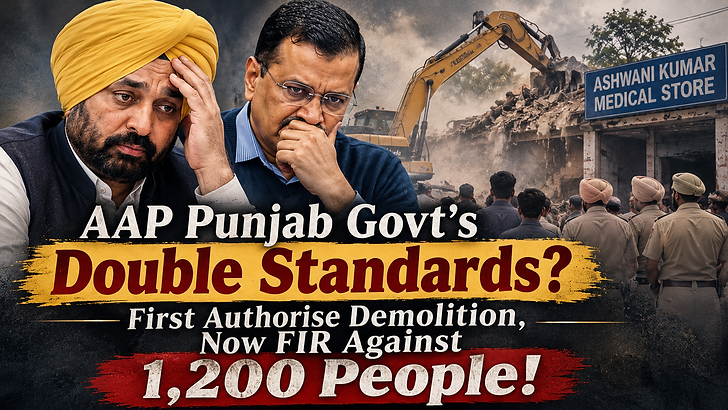
The Bhagwant Mann government is facing questions over its handling of the Ashwani Kumar case, with reports of an FIR against around 1,200 unidentified people raising concerns about selective accountability, political messaging and the government's response to public anger.
The controversy surrounding the demolition of Ashwani Kumar's medical shop and house has taken another turn, raising serious questions about the Punjab government's approach and the conduct of the Punjab Police.
The central question is straightforward: if the government publicly defended the demolition and stood behind the action, why has a case reportedly been registered against approximately 1,200 unidentified people in connection with the demolition of the medical shop?
From bulldozer action to an FIR: What changed overnight?
On October 14, following the killing of anti-drug activist Parvinder Singh, alias Jhota, in Mansa, anger erupted across the region. Ashwani Kumar, the owner of the medical store where Jhota was shot, was arrested in Rajasthan.
Soon afterwards, the district administration initiated demolition action against a portion of Kumar's house, citing alleged unauthorised construction. At the medical shop, an administration-arranged JCB initially pulled down part of the structure before protesters took over, demolished the remaining portion and set it on fire.
The incident unfolded in the presence of a heavy police deployment. The Bathinda DIG subsequently said the demolition had been carried out after completing the required legal formalities.
The government's response appeared to align itself with the public anger surrounding Jhota's killing. The authorities defended their action, while the administration's presence at the demolition gave the impression that the government was responding firmly to public sentiment.
However, the subsequent developments have raised a different set of questions.
FIR against 1,200 unidentified people
According to a Times of India report published on November 5, Mansa Police had registered FIR No. 270 on October 15 against up to 1,200 unidentified people in connection with the demolition and arson at Ashwani Kumar's medical shop.
The FIR reportedly includes charges relating to rioting, unlawful assembly and destruction of property under the Bharatiya Nyaya Sanhita.
The complaint was filed by ASI Amrik Singh. The police complaint reportedly states that a mob took control of a JCB and demolished the medical store before setting it on fire, in the presence of police personnel.
This raises an uncomfortable question for the Bhagwant Mann government: if the administration itself had initiated demolition proceedings and the police were present throughout the incident, why did the situation subsequently result in a case against such a large number of unidentified people?
Was the demolition an officially supported administrative action, an uncontrolled public protest, or a combination of both? The government and police owe the public a clear explanation.
Selective accountability and political convenience?The bigger concern is not whether those responsible for vandalism should face the law. Nobody should be above the law, and destruction of property cannot simply be justified because public anger is understandable.
The real issue is consistency.If the Punjab Police believes that people involved in demolishing the medical shop should face criminal proceedings, the same standard of accountability must apply to every official and authority involved in the entire episode.
The government cannot appear to endorse an action when it suits the political atmosphere and subsequently distance itself from the consequences when legal questions arise.
It is particularly important to establish who authorised the demolition, what legal notices and orders were issued, what role the police played, and whether evidence from the crime scene was properly preserved.
The Punjab and Haryana High Court has also sought a status report from the state government, including clarification about the demolition and the legal procedure followed.
Is the government managing public emotions instead of delivering justice?
The death of Parvinder Singh Jhota was not an ordinary criminal incident. He was known for his campaign against drug abuse and the alleged illegal sale of addictive substances.
His killing generated enormous public anger because it touched upon one of Punjab's most serious social and political concerns: the continuing drug problem.
People wanted justice, accountability and a credible investigation. They wanted answers about the alleged drug trade, the people operating such networks and the institutions responsible for stopping them.
But justice cannot be delivered through bulldozers, public spectacle or political statements.
The government must not confuse public anger with public confidence. Nor should it use emotionally charged situations to create an impression of decisive action without ensuring that the legal process is followed.
The subsequent FIR against approximately 1,200 unidentified people makes the government's position even more difficult to explain.
The questions Bhagwant Mann and Punjab Police must answer
Punjab deserves justice, not political drama
The Bhagwant Mann government came to power promising a decisive battle against drugs and a new political culture. Yet incidents such as this raise serious questions about the gap between political promises and governance.
The killing of Jhota deserves a transparent and independent investigation. Those responsible must face the law. Anyone involved in unlawful destruction of property must also be held accountable through due process.
But accountability cannot be selective, and the law cannot operate differently depending on which political narrative the government wants to promote.
The government cannot take political credit for appearing tough in the immediate aftermath of a tragedy and then leave the public confused about its own role when legal accountability becomes an issue.
Punjab needs answers, not another round of political messaging. Justice for Jhota must not become another opportunity to manage public emotions while the bigger questions about drugs, governance and accountability remain unanswered.
Editorial note: This article distinguishes between reported facts, allegations and political criticism. The FIR does not by itself establish that the government ordered or endorsed the shop's destruction. The administration's role, police conduct and the legal basis for the demolition require transparent examination.