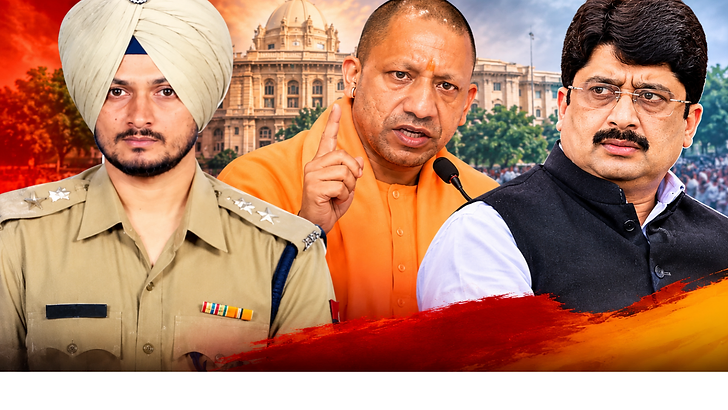
The IPS Officer Who Challenged Yogi Adityanath and Raja Bhaiya Is Back on Duty After Nearly Eight Years
Jasvir Singh, the outspoken Punjab-born IPS officer who took on politically sensitive cases involving some of Uttar Pradesh's most powerful politicians, has been reinstated after spending 93 months under suspension. His return raises uncomfortable questions about political influence, police independence and the price officers may pay for challenging those in power.
An Indian Police Service officer who once recommended invoking the National Security Act against Yogi Adityanath and investigated an alleged multi-crore foodgrain scam involving powerful Uttar Pradesh politician Raja Bhaiya is finally back in service.
Jasvir Singh, a 1992-batch IPS officer of the Uttar Pradesh cadre, has been reinstated by the Uttar Pradesh government after nearly eight years of suspension.
His suspension, which began on February 14, 2019, was revoked on November 16, 2026, bringing an end to one of the longest suspension periods involving a senior police officer in the state.
But his return is not simply another administrative development. It revives a larger debate about whether police officers in India can independently perform their duties when their investigations or decisions involve politically influential individuals.
For many observers, Singh's career represents the difficult position faced by officers who attempt to maintain professional independence in a system where political influence can play a significant role in policing and administration.
Who is Jasvir Singh?
Born on January 15, 1968, in Punjab's Hoshiarpur district, Jasvir Singh comes from a military family. His father, Arjan Singh, served as a Havildar in the Indian Army.
Singh completed a Bachelor of Engineering degree in Civil Engineering before clearing the UPSC examination and joining the Indian Police Service.
He belongs to the 1992 IPS batch and was allotted the Uttar Pradesh cadre, formally joining the service on September 5, 1993.
Over more than three decades, he served in several important police assignments across Uttar Pradesh, including positions as Superintendent of Police, Deputy Inspector General, Inspector General and Additional Director General.
However, it was not simply his career progression that brought him into the national spotlight. It was his involvement in politically sensitive cases involving some of Uttar Pradesh's most influential political figures.
When he recommended NSA action against Yogi Adityanath
One of the most significant episodes in Singh's career dates back to 2002.At the time, Yogi Adityanath was a Member of Parliament from Gorakhpur and an influential political figure in eastern Uttar Pradesh.
While serving as Superintendent of Police in Maharajganj, Singh initiated proceedings recommending the imposition of the National Security Act (NSA) against Adityanath in connection with a case involving alleged violations of prohibitory orders.
The recommendation brought the police officer into direct conflict with a politically powerful figure.
Singh was reportedly transferred shortly afterwards.
The episode became one of the defining chapters of his career and established his reputation as an officer willing to take action in politically sensitive matters.
Years later, Yogi Adityanath would become the Chief Minister of Uttar Pradesh.
The Raja Bhaiya foodgrain scam investigation
Another controversial chapter involved Raghuraj Pratap Singh, popularly known as Raja Bhaiya, a powerful politician in Uttar Pradesh.
In 2003, while associated with the Uttar Pradesh Police's Food Cell, Jasvir Singh was involved in investigating an alleged multi-crore foodgrain scam involving irregularities in the distribution of foodgrains in districts including Lakhimpur Kheri and Sitapur.
The investigation brought the name of Raja Bhaiya, who was then a minister, into the controversy.
The matter was subsequently transferred to the Central Bureau of Investigation (CBI).
Taking on influential political figures in separate cases made Singh a prominent and controversial figure within Uttar Pradesh's police establishment.
The 2019 interview that changed his careerThe biggest turning point came in January 2019.
While serving as Additional Director General (Rules and Manuals), Singh gave an interview to HuffPost in which he openly questioned the functioning of the Uttar Pradesh Police.
He raised concerns about the police encounter policy, political influence over police postings and the way officers were assigned responsibilities.
He also spoke about his own experience within the police establishment and questioned whether officers were being given meaningful opportunities to perform their professional duties.
His comments attracted attention because they came from a senior serving IPS officer rather than an outside political commentator.
The state government sought an explanation, treating his remarks as a possible violation of the All India Services (Conduct) Rules.
The government also cited his alleged unauthorised absence from duty from February 4, 2019, without prior permission or intimation to the competent authority.
On February 14, 2019, he was placed under suspension. Nearly eight years outside active service
What followed was an extraordinary period in Singh's professional life.
For approximately seven years and nine months, he remained suspended while departmental proceedings and administrative reviews continued.
The prolonged suspension effectively stalled his career progression while several officers from his batch moved into more senior positions.
Singh also approached the Central Administrative Tribunal and made representations to the state Home Department and the UPSC regarding his case.
His suspension was eventually revoked through a government order dated November 16, 2026.
According to reports, he has returned at the rank of Additional Director General and has been attached to the Police Headquarters in Lucknow in a waiting capacity, pending a regular posting.
He is expected to retire in January 2028.A question bigger than one police officer
The reinstatement of Jasvir Singh deserves attention beyond the individual circumstances of his career.
India's police system operates within a political and administrative structure in which state governments exercise significant control over police administration, appointments and transfers.
While elected governments have legitimate authority over administration, the independence of law enforcement is equally important in a functioning democracy.
Police officers must be able to investigate allegations, enforce the law and act professionally without fear of political retaliation.
The real test of a democratic system is not whether its institutions can act against ordinary citizens, but whether they can also act impartially when powerful politicians and influential individuals are involved.
Singh's supporters may see him as an example of an officer who refused to compromise his professional convictions despite the consequences. His case also raises questions about how long disciplinary proceedings can remain unresolved and whether prolonged suspension can become a punishment in itself.
His reinstatement does not automatically establish that every action taken against him was politically motivated, nor does it erase the government's stated disciplinary grounds. But the extraordinary length of the suspension and the politically sensitive history of his career deserve serious public scrutiny.
Jasvir Singh is back in service, but the bigger question remains: How many officers in India's administrative and law enforcement systems would be willing to challenge powerful politicians if doing so could cost them years of their careers?
For a democracy, an independent police force should not depend on the personal courage of individual officers. It should be guaranteed by the strength of its institutions.
And that is perhaps the most important lesson from the Jasvir Singh story.