
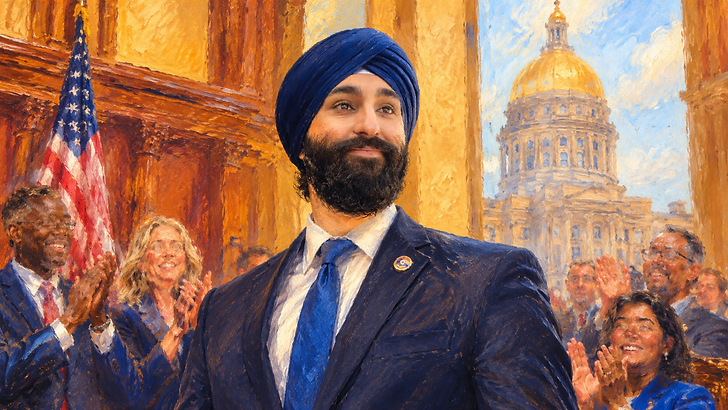
From a working-class Sikh immigrant family to the Georgia State House, Jyot Singh's historic victory represents more than political success. At a time when immigration, racial identity and national belonging are increasingly weaponised in Western politics, his election sends a powerful message about representation and democratic inclusion.
In a political climate increasingly shaped by anti-immigration rhetoric, racial polarisation and the growing influence of far-right movements, the election of Jyot Singh as Georgia's first Sikh legislator is a particularly significant moment for the Sikh community and immigrant communities across the United States.
The 27-year-old Democrat has made history by winning Georgia House District 97 in the November 3, 2026, US midterm elections. His victory makes him the first Sikh American and the first Indian American elected to the Georgia General Assembly.
Singh defeated Republican candidate Yassin Moghazy, securing approximately 68 per cent of the vote. He will take his seat when the Georgia General Assembly convenes in January 2027.
For a community that has contributed to American society for generations but remains underrepresented in political institutions, this is an important breakthrough.
A Sikh immigrant's son enters the corridors of power,
Jyot Singh's journey reflects the experiences of many immigrant families who arrive in Western countries with limited resources but ambitious hopes for the next generation.
The son of Sikh immigrants from Punjab (India), Singh grew up in a working-class family in Norcross, Georgia. He has spoken about his childhood experiences of living in basement apartments and townhouses and beginning work at just 15 years of age to help support his family.
He later graduated from Yale University in 2021 with a degree in Global Affairs and built a career in community organising, political communications and consulting.
His campaign focused on issues that extend beyond identity politics, including affordable housing, healthcare, public education, the cost of living and the concerns of working-class and immigrant communities.
His election campaign also had a strong connection with the Sikh community. Campaign events began and concluded at Guru Nanak Mission Society in Norcross, where members of the community celebrated his victory with the traditional Sikh greeting, "Bole So Nihal, Sat Sri Akal".
Singh has said that the Sikh tradition of standing against tyranny, oppression and injustice, while uplifting all communities, will guide his work in the legislature.
That message carries particular significance in the current political environment.
A historic victory at a time of growing anti-immigrant politics
Across several Western democracies, immigration has become one of the most contentious political issues. Political movements built around nationalism, cultural exclusion and hostility towards migrants have gained influence, while racial and religious minorities increasingly find themselves at the centre of political debates about national identity.
The United States provides one of the most prominent examples.Under President Donald Trump's administration, immigration enforcement has expanded dramatically. Immigration and Customs Enforcement (ICE) has become a central instrument of the administration's mass deportation agenda.
The consequences have extended well beyond undocumented immigration. Immigration raids, detention practices and enforcement operations have generated widespread fear in immigrant communities, including among families with mixed immigration status.
A Human Rights Watch report published in June 2026 documented 52 deaths in ICE custody between January 2025 and June 4, 2026, while reporting that the detention population had reached record levels.
Amnesty International's September 2026 investigation also raised serious concerns about racial discrimination, arbitrary detention, excessive force, intimidation and violations of due process during federal immigration enforcement operations.
These findings have intensified the debate about the balance between border enforcement, national security, civil liberties and human rights.
It is important to distinguish legitimate immigration policy debates from rhetoric that collectively portrays immigrants as a threat. A country has the right to regulate its borders, but immigration enforcement must remain subject to the rule of law, human dignity and constitutional protections.
This is precisely why the election of someone like Jyot Singh matters.
At a time when some political voices are attempting to narrow the definition of who belongs in America, a Sikh American entering the state legislature represents another side of the American story.
His victory demonstrates that democratic participation is not determined by religion, skin colour, birthplace or family background.
More than a Sikh victory: America elects a diverse new generation
Jyot Singh's election was part of a much wider wave of historic victories by candidates from minority communities in the 2026 US elections.
Several candidates broke longstanding political barriers, winning positions that had never previously been held by members of their respective communities.
Among the notable victories were:
Muslim American representation,/h1>
Indian American representation
Jyot Singh became the first Sikh and Punjabi (Indian) American elected to the Georgia General Assembly.Native American representation
Latino and Hispanic representation
Black and African American representation
These victories demonstrate the increasingly diverse character of American political life. They also show that minority communities are no longer simply participating in elections as voters and campaign volunteers; they are increasingly becoming the people making laws, shaping policy and exercising political power.
Representation is important, but it must translate into change
The significance of these electoral victories should not be measured only by the identities of the winners.
Having a Sikh, Muslim, Indian American, Native American, Latino or Black representative in public office is an important milestone. However, representation must also translate into meaningful policies, equal opportunities and protection of civil liberties.
Minority representatives will face the challenge of addressing the concerns of their own communities while serving the wider population.
For Jyot Singh, that means representing not just Sikh Americans or Indian Americans, but every constituent in Georgia's District 97.
His success also creates an opportunity for greater awareness of Sikh identity in American public life. Sikhs have lived in the United States for generations, contributing to business, agriculture, education, public service and the armed forces. Yet, visible Sikh identity, particularly the turban and uncut hair, has often been misunderstood and has sometimes exposed members of the community to discrimination and hate.
Political representation can help challenge stereotypes and create a more informed understanding of the Sikh faith and its values.
A message that resonates beyond America
For Sikhs and immigrant communities in Australia, Canada, the United Kingdom and Europe, Jyot Singh's victory has significance far beyond the boundaries of Georgia.
These countries have all experienced increasingly heated debates about immigration, multiculturalism, national identity and the place of minority communities in public life.
The rise of political movements that exploit economic insecurity and social anxieties by blaming migrants and minorities is a challenge to the principles of inclusive democracy.
The answer cannot simply be to demand tolerance from the majority. Minority communities must also have meaningful opportunities to participate in democratic institutions, influence policy and occupy positions of leadership.
Jyot Singh's victory offers an encouraging example of what that participation can achieve.
His election does not mean that discrimination has disappeared or that the challenges facing immigrant communities have been resolved. Nor does one electoral victory reverse the wider political trends towards exclusion and nationalism.
But it does demonstrate that those trends are not inevitable.
A young Sikh man, born into an immigrant family, who once worked to support his household, is now preparing to enter Georgia's legislature. That is a powerful statement about the possibilities of democratic participation.
In an era when some political movements are attempting to build walls around national identity, Jyot Singh's election sends a different message: democracy becomes stronger when more communities have a seat at the table.