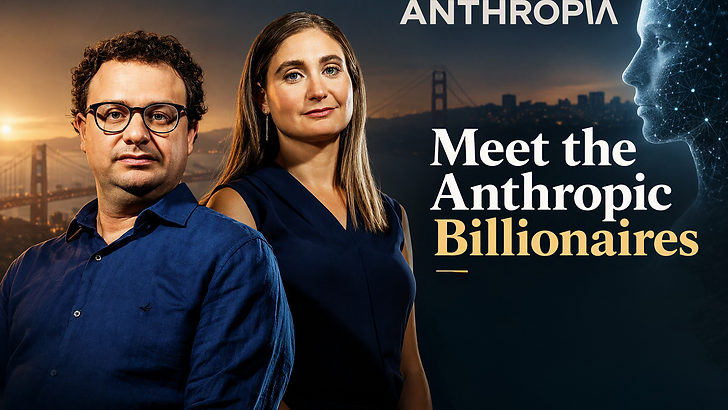
Artificial intelligence has created a new generation of technology billionaires, and few companies illustrate this better than Anthropic. Founded in 2021 by a group of former OpenAI researchers and executives, Anthropic has rapidly become one of the world's most influential AI companies, best known for developing the Claude family of AI models. Recent market developments have dramatically increased the wealth of its founders, turning several of them into multi-billionaires.
But who are the people behind Anthropic, and why does their rise matter for the future of artificial intelligence?
The Anthropic Story
Anthropic was founded by seven former OpenAI employees who left to build an AI company focused on safety, reliability, and long-term alignment with human values. The company positioned itself as a public-benefit corporation with a strong emphasis on responsible AI development.
The founders include:
Together, they created a company that has grown into one of the leading competitors in the global AI race.
Dario Amodei: The Scientist CEO
Dario Amodei is the public face of Anthropic. Before founding the company, he worked at Google Brain and later became Vice President of Research at OpenAI, where he contributed to the development of GPT-2 and GPT-3. He holds a PhD in biophysics and computational neuroscience and is widely regarded as one of the world's most influential AI researchers.
Amodei has consistently argued that AI systems are becoming increasingly powerful and that safety research must advance as quickly as capabilities. His views have helped shape Anthropic's identity as a company that seeks to balance innovation with caution.
Daniela Amodei: The Strategic Leader
Daniela Amodei, Dario's sister, serves as Anthropic's President. Although her background is less technical, she played important roles at OpenAI in operations, safety, and people management before co-founding Anthropic.
She has been instrumental in building the organisation, managing growth, and establishing relationships with governments, research institutions, and corporate partners. Many observers view her as one of the key architects of Anthropic's culture and governance model.
The Other Founders
While Dario and Daniela attract most of the media attention, Anthropic's success depends heavily on its other co-founders:
Jared Kaplan
Anthropic's Chief Science Officer, Kaplan is a theoretical physicist whose research has helped drive advances in large language models and scaling laws.
Jack Clark
Formerly a journalist and policy expert, Clark leads public-benefit and policy initiatives. He has become one of the most respected voices on AI governance and regulation.
Tom Brown
Known for his work on large-scale AI training systems, Brown serves as a key technical leader behind Anthropic's infrastructure and model development.
Sam McCandlish
A specialist in machine-learning optimisation and scaling, McCandlish has contributed significantly to the engineering foundations of Claude models.
Chris Olah<.h2>
One of the industry's most respected AI interpretability researchers, Olah focuses on understanding how neural networks think and make decisions.
The Rise of New AI Billionaires
According to multiple reports, the rapid growth of Anthropic has pushed each of its seven co-founders into the ranks of the world's wealthiest individuals, with fortunes estimated in the tens of billions of dollars. Recent public-market activity and investor enthusiasm have dramatically increased the value of their ownership stakes.
What makes this remarkable is that most of these individuals were researchers rather than traditional entrepreneurs. Their wealth reflects how valuable advanced AI technology has become in the global economy.
Why This Matters for the Future of AI
1. Scientists Are Becoming Industry Leaders
In previous technology revolutions, business executives often controlled the largest companies. In the AI era, many company leaders come directly from research backgrounds. This means scientific priorities may increasingly influence commercial decisions.
2. AI Safety Is Becoming a Competitive Advantage
Anthropic has built its brand around responsible AI development. Its success suggests that safety and profitability are no longer seen as opposites. Instead, businesses and governments increasingly want trustworthy AI systems.
3. The AI Race Is Intensifying
Anthropic now competes directly with OpenAI, Google DeepMind, Meta, and other major AI players. This competition is accelerating innovation in areas such as reasoning, coding, scientific research, and business automation. The result is likely to be more powerful AI systems arriving faster than many experts expected.
4. Enormous Wealth Means Enormous Influence
As Anthropic's founders become among the wealthiest figures in technology, they gain significant influence over research funding, public policy, philanthropy, and AI governance. The choices they make could affect how AI develops over the coming decades.
The Anthropic billionaires are not typical tech moguls. Most are researchers, scientists, and AI safety advocates who left established organisations to build a company around a vision of responsible artificial intelligence. Their success reflects the extraordinary value that society now places on advanced AI.
Whether Anthropic ultimately becomes the dominant AI company is still uncertain. What is clear is that the people behind it are helping shape one of the most important technological transformations in history. Their decisions about safety, governance, and innovation may influence not only the future of AI, but also the future of work, education, healthcare, and scientific discovery itself.