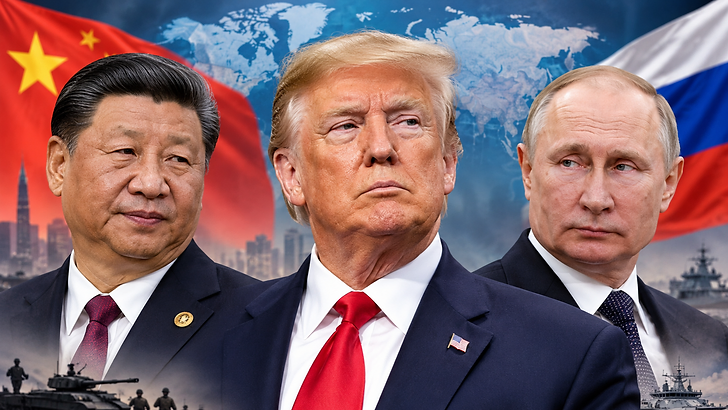
The leaders of the United States, China and Russia Donald Trump, Xi Jinping and Vladimir Putin held an unprecedented trilateral meeting in Shenzhen, China, on 19 November, on the sidelines of the Asia-Pacific Economic Cooperation summit. It brought together the leaders of the world’s largest economies and military powers, but produced broad pledges rather than concrete solutions to the wars and economic pressures reshaping global life.
What they achieved
The three leaders issued a “Declaration toward Peace,” committing to dialogue on reducing nuclear risks and preventing proliferation, reforming the United Nations, supporting stable energy flows, and increasing production and supply of refined petroleum products. They also called for limits on what they described as the misuse of jurisdiction by the International Criminal Court and similar bodies.
The most significant immediate result was diplomatic rather than practical: the first-ever three-way meeting between the US, Chinese and Russian presidents. The leaders discussed Ukraine, Iran, nuclear weapons, trade tensions and artificial intelligence, and agreed to continue talking but announced no ceasefire, troop withdrawal, sanctions relief, arms-control timetable or binding peace plan.
What it means for the world
For ordinary people, the meeting matters because the decisions or indecision of Washington, Beijing and Moscow shape energy prices, food security, trade, military spending and the risk of wider war. The three countries are permanent members of the UN Security Council, giving them exceptional power to enable or block international action.
A joint commitment to “strategic stability” and nuclear-risk reduction could be meaningful if it leads to real negotiations. But the declaration did not include specific reductions in nuclear weapons or a schedule for talks, leaving the world’s most dangerous weapons largely governed by rhetoric for now.
Their share of global conflict
It would be inaccurate to blame every war on these three governments alone. Local armed groups, regional powers, weak institutions, climate pressures and historical grievances all contribute to conflict. Yet the policies and rivalries of the US, China and Russia have an outsized effect because of their military reach, economic weight, veto power at the UN and influence over arms, finance and technology.
Russia bears direct responsibility for its ongoing war in Ukraine, which has caused mass civilian casualties, displacement and destruction. The United States and its allies have armed and financed Ukraine’s defence, while China has maintained close political and economic ties with Russia; all three powers therefore influence whether the war ends through negotiation, escalation or prolonged fighting.,?p>
The meeting itself did not resolve the central question: the joint statement reportedly did not mention Russia’s war in Ukraine or the US-led war in Iran, despite those conflicts being central to global instability.
Why costs keep rising
Wars raise prices far beyond the battlefield. Attacks on infrastructure, disrupted shipping, sanctions, insurance costs and uncertainty around oil and gas supplies push up transport, food, manufacturing and household-energy costs worldwide. The leaders’ promise to increase refined petroleum production and maintain stable energy flows acknowledges that link, but it is not yet a detailed plan to protect consumers.
Trade tensions add another burden. Tariffs, export controls and fragmented supply chains make goods more expensive and slow investment, while governments divert public money from hospitals, schools and housing toward defence. A serious agreement among the three powers could lower uncertainty; without enforcement, businesses and households will continue paying the price of geopolitical risk.
Will it make a difference?
Possibly but not yet. The summit may matter if it opens a durable channel between leaders who rarely meet as a trio, particularly on nuclear risk, energy markets and UN reform. Analysts, however, had low expectations beforehand, and the outcome so far supports their caution: the declaration was largely general, with no immediate breakthrough on the world’s most explosive conflicts.
The real test will be whether follow-up talks produce measurable results: a credible path to ending the Ukraine war, protection of civilians, nuclear-risk negotiations with timelines, and policies that ease energy and trade costs. Until then, the meeting is best seen as a signal that the world’s most powerful countries recognise the stakes not yet as proof that they are prepared to end the conflicts they help shape