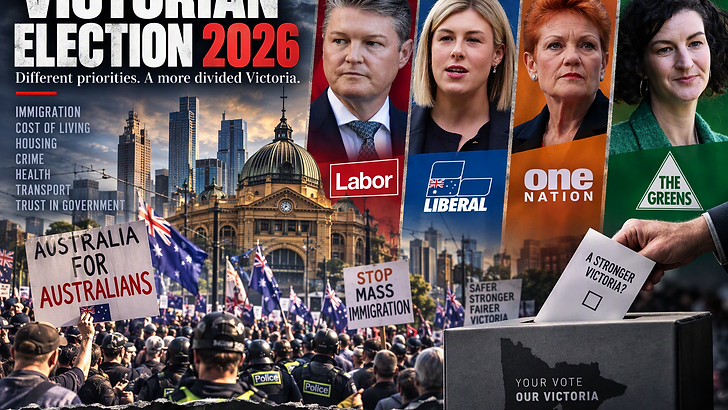
As Victorians prepare to head to the polls, the issues dominating public discussion are not all traditionally state matters. While cost of living, housing, crime, health services and transport remain central concerns, the federal issue of immigration has emerged as a powerful force shaping voter sentiment across the state election campaign.
Political analysts say immigration has become a proxy for broader frustrations about housing affordability, infrastructure pressure and the rising cost of living. Although immigration policy is controlled by the Commonwealth Government, debate over population growth is increasingly influencing state politics and voter behaviour.
The shift has created fertile ground for parties and movements campaigning on anti-immigration platforms. Right-wing activist groups have increased their visibility across Victoria over the past year, while several anti-immigration demonstrations have drawn large crowds in Melbourne. Some protests have resulted in confrontations between rival groups, highlighting growing political polarisation in the state's capital.
Labor Facing Headwinds After More Than a Decade in Office
After 12 years of Labor government in Victoria, Premier-led administrations are confronting a familiar political challenge: voter fatigue.
Even among voters who acknowledge major infrastructure projects and public investment, there is a growing perception that successive governments have become complacent. Rising state debt, cost-of-living pressures, concerns about crime and dissatisfaction with public services have combined to create a difficult political environment for the government.
The challenge for Labor is compounded by the fact that many voters frustrated with housing affordability and infrastructure pressures often connect those concerns with high levels of migration, regardless of whether immigration is controlled by Canberra rather than Spring Street.
That dynamic has allowed opposition parties to campaign on broader themes of change and accountability.
Rise of One Nation Reshapes Political Landscape
One of the most significant developments of the campaign has been the growing influence of One Nation.While the party remains unlikely to form government, its polling strength has made it a significant player in several marginal seats. The party's focus on immigration, law and order, government spending and cultural issues has resonated with a segment of voters dissatisfied with both major parties.
Political observers note that One Nation's growing support mirrors trends seen in other Western democracies, where anti-establishment and populist movements have gained traction amid concerns about economic insecurity and rapid social change.
The rise of One Nation has also intensified pressure on the Liberal Party.
Liberals Walking a Fine Political Line
Preference flows from One Nation could prove decisive in a number of close contests. As a result, Labor has accused the Coalition of softening its language on issues important to right-wing voters and avoiding direct confrontation with One Nation in key policy areas.
Coalition figures reject suggestions they are moving significantly to the right, arguing they are responding to legitimate voter concerns about housing, infrastructure capacity, crime and cost-of-living pressures.
Nevertheless, political analysts say the Liberal Party has increasingly focused its messaging on law and order, government debt, population pressures and community safety, issues that also feature prominently in One Nation campaigning.
Role of Right-Wing Media
Media outlets, podcasts and online commentators operating outside traditional mainstream news organisations have also become increasingly influential during the campaign.
Many have focused heavily on immigration, crime and cultural issues, helping drive public discussion on topics that receive comparatively less attention in official state election policy debates.
Supporters argue these platforms are addressing concerns overlooked by established media. Critics contend they amplify community tensions and simplify complex policy issues.
Regardless of perspective, few dispute their growing influence over political discourse.
A State Election Influenced by National Anxiety
Ultimately, the 2026 Victorian election appears to be about more than roads, hospitals and public transport.
The contest has become intertwined with broader national debates over immigration, economic pressures and trust in government. Voters angered by rising costs and housing shortages are increasingly looking for alternatives, creating opportunities for insurgent parties and forcing the major parties to adapt.
For Labor, the challenge is convincing voters that experience and stability outweigh the desire for change after more than a decade in office.
For the Liberals, the task is to capture that desire for change without becoming overly dependent on the support of right-wing populist movements.
And for One Nation, the election offers a chance to convert growing public frustration into lasting political influence.
As polling day approaches, the result may reveal not only the future direction of Victoria, but also the extent to which federal debates about immigration and identity are reshaping state politics.